If you are sourcing foam for an ECG electrode, a wearable patch or a grounding pad, you will see the phrase "medical-grade PE foam" on almost every supplier page. The phrase is useful, but it is not a certification. There is no single stamp that makes a foam roll medical-grade. The term really means a collection of evidence: a controlled structure, consistent coating, skin-contact safety data, and a supplier who can document all three.
1. What the roll actually is
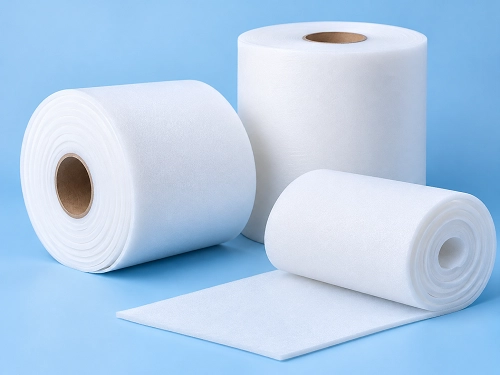
A PE foam electrode roll is a three-layer laminate: a crosslinked polyethylene (IXPE) foam carrier, a medical acrylic adhesive, and a PET release liner. The converter slits, rewinds and die-cuts the roll into finished pads or patch components. FULUO's PE Foam Electrode Rolls follow this construction. They are supplied on 3-inch paper cores, with standard or aggressive adhesion levels.
Crosslinking is the detail that matters most here. Compared with standard PE foam, crosslinked foam generally has a finer and more uniform cell structure. That gives more predictable compression and cleaner cut edges when the material is punched into small shapes at speed. It is the main reason IXPE is common in electrode and patch converting.
2. Five parameters, and what each one changes
Most RFQs list "foam, acrylic adhesive, PET liner" and stop. The parameters below are the ones that decide whether a roll runs well on your line and wears well on the patient. FULUO lists all of them as customizable, rather than fixed.
| Parameter | What it affects | Practical consideration |
|---|---|---|
| Foam expansion ratio | Softness, cushioning, recovery after compression | Softer foam suits sensitive skin or pressure points. Firmer foam holds its shape better in small die-cuts. |
| Foam thickness | Conformability, cut-edge definition, device profile | A thin build looks discreet on a wearable. A thicker one cushions better. Check that it still conforms where the body flexes. |
| Tensile strength | Web handling during slitting, rewinding and punching | Low strength can stretch or tear on fast lines. Too stiff can reduce comfort. |
| Adhesive level and coating weight | Initial tack, wear-time stability, removal trauma | Standard or aggressive adhesion, plus adjustable coating weight, lets you balance fixation against gentle removal. |
| Release liner and roll format | Liner release on automatic lines, compatibility with your equipment | PET liner on 3-inch paper cores. Jumbo roll width and length can be customized to match your line. |
A tip from the converting side: treat the adhesive and foam as a pair, not as two separate choices. A strong adhesive on a very soft foam can stretch the carrier during removal, and a firm foam with weak adhesive may lift at the edges. Ask for samples in two or three combinations and test them on your actual line and with your actual skin-contact protocol.
3. Where the standards come in
A foam roll is a component, not a finished device. The standards that govern the finished product still shape what you should ask your foam supplier for.
ECG electrodes. ANSI/AAMI EC12 sets minimum labeling, safety and performance requirements for disposable electrodes used in diagnostic ECG or ECG monitoring.[1] Its limits apply to the whole electrode system, not to the foam alone. A published study comparing a textile electrode with the standard lists limits such as DC offset voltage below 100 mV and AC impedance below 3 kΩ.[2] The standard also excludes electrodes designed to deliver therapeutic energy and does not cover electrolyte composition.[3] Foam does not set impedance, but it influences how steadily the electrode sits against the skin. That is why consistent thickness and adhesive weight matter during qualification.
Skin-contact biocompatibility. FDA's September 2023 guidance on ISO 10993-1 describes how to determine whether device materials could cause an unacceptable biological response.[4] It also includes a policy for certain devices that touch only intact skin. In FDA's own explanation of that policy, it applies regardless of contact duration, but it excludes mucosal membranes and open or healing wounds. FDA also recommends a pre-submission discussion if marketed devices have shown clinical findings related to cytotoxicity, irritation or sensitization.[5]
In practice, this means the biocompatibility conclusion belongs to the device manufacturer, who has to account for the foam, the adhesive, the gel and any other skin-contact materials together. A good roll supplier cannot take that responsibility away, but it can make the conversation easier by providing material information and test documentation on request. Regulations differ by market, so confirm requirements with your regulatory team or notified body.
4. What goes wrong on the line
Most roll-related problems show up as converting problems before they show up as clinical ones. These are the failure patterns worth planning for. They come from general converting practice, not from any single supplier's data.
- Misfeeds and registration drift. Variation in thickness or tension across a jumbo roll can push die-cut registration off. Ask how thickness uniformity is checked across the web width.
- Edge lift after cutting. Adhesive that is too thin, or foam with high recovery, can pull away at the pad edge. Run an aging and flex test, not just a bench peel test.
- Liner problems. Liner that releases too easily can lift during conversion. Liner that releases too stiffly can tear the foam when the operator peels it. Test the full cycle from die-cut to application.
- Roll-to-roll variation. A good first sample means little if the third lot behaves differently. Ask what is recorded per lot and what you receive with each shipment.
- Skin reactions. Strong adhesion helps motion stability but increases the risk of removal trauma. Choose the lowest adhesion level that holds through your realistic wear scenario.
5. Matching the roll to the application
FULUO lists several end uses for its PE foam rolls, and each one pushes the specification in a different direction. ECG and monitoring electrodes usually prioritize secure adhesion through movement, so a thinner foam with a stronger adhesive is a common starting point. Wearable patches and biosensors tend to prioritize comfort over days of wear, which favors softer, lightweight foam and careful adhesive selection. Grounding pads and electrosurgical accessories carry additional safety requirements beyond the foam itself, so treat the foam as only one part of a larger qualification. Catheter securement and general device fixation need gentle skin contact and dependable hold.
If your design does not need cushioning, other substrates may fit better. FULUO's PU film adhesive rolls suit thin, transparent, waterproof coverings, and its non-woven adhesive rolls suit breathable fixation. For elastic support products, see the kinesiology tape jumbo rolls. The full range is on the Medical Roll Materials page.
6. A supplier checklist you can reuse
| Ask the supplier | Why it matters | A useful answer looks like |
|---|---|---|
| Which foam, adhesive and liner structure is offered, and which are adjustable? | Defines how much you can tune the roll to your device. | A written spec sheet with the adjustable variables named. |
| How is coating weight and thickness verified per lot? | Drives roll-to-roll consistency on automatic lines. | A described inspection method and records you can request. |
| What material and test documentation can you share for skin-contact evaluation? | Feeds your own biocompatibility file. | Specific documents offered, with the limits of what the supplier tested stated honestly. |
| Can you supply development samples in several adhesive and foam combinations? | Lets you test on your own line before committing. | Clear sample terms and a realistic lead time. |
| What roll widths, lengths and core sizes do you run? | Avoids rework on your slitting and rewinding setup. | Confirmed formats that match your equipment. |
7. What FULUO brings to this
FULUO Medical has manufactured medical adhesive materials in Zhejiang since 2007, covering coating, laminating, slitting and rewinding. According to its Why Choose Us page, the company operates two independent laboratories, with full-time inspectors working on microbial detection, environmental monitoring and physical and chemical performance testing. It also lists a 500 m² GMP 100,000-class workshop and three production lines, with separate workshops for coating, cutting and packing.
For PE foam, the offer on the product page covers IXPE carrier, medical acrylic adhesive at standard or aggressive levels, PET liner, 3-inch cores, and customization of expansion ratio, thickness, strength, coating weight, color and jumbo roll dimensions. If you are comparing foam options for an electrode build, the company's ECG electrode foam material guide and its PE foam electrode roll technical guide cover the construction and process in more detail. For private-label or tailored programs, the OEM & Customization page explains how custom projects are handled.
Two points are worth stating plainly. The published specification does not give numeric ranges for thickness, density or adhesion strength, so request a datasheet and samples for your project. And FULUO supplies roll material for converters rather than finished electrodes, so your own team stays responsible for validating the final device.
Frequently asked questions
Is "medical-grade" a regulated term for foam rolls?
Not by itself. The regulated item is the finished medical device, and its manufacturer must show the materials are suitable for the intended use. A supplier's claim is a starting point, so ask for the supporting documentation.
How is IXPE different from ordinary PE foam?
IXPE is crosslinked, which generally gives a finer, more uniform cell structure, steadier compression and cleaner die-cut edges. That makes it better suited to small, precise pad shapes.
Do I need standard or aggressive adhesion?
Start from wear time and activity level. Short-term, high-movement monitoring may need stronger adhesion, while longer wear on sensitive skin usually favors the gentler level or a reduced coating weight. Test both on your own line.
Where can I request samples or a datasheet?
Use the Contact Us page or email fuluo@jxfuluo.com, and include your target application, roll width and adhesion requirement.